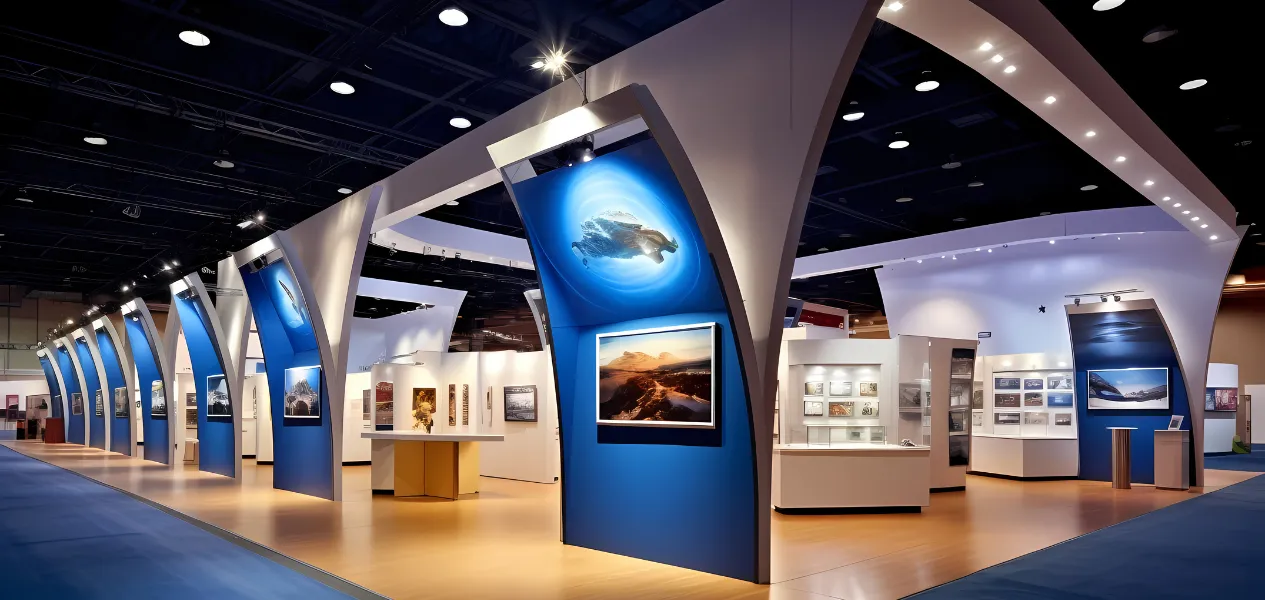
Exhibition floor plans are straightforward on paper. A few dimensions, a grid, and a booking form. But when you’re actually in the exhibition hall, those figures begin to behave in rather different ways. The size of your stand is more than just a measure of the space you have. It’s a measure of how people interact with you.
Most brands don’t decide on a stand size. They are handed one. Whatever is available. Whatever fits the budget. Whatever looked right last year. That’s where the trouble usually begins. Let’s take a step back and examine what different stand sizes actually do in the real world.
A 3x3 stand leaves you with nowhere to hide. This is not necessarily a negative thing. A 3x3 stand is a format that forces brands to make decisions. You can’t display everything, which means you have to decide what is important. When brands go wrong with 3x3 stands, it is often because they are trying to fit an entire brochure’s worth of information into nine square meters. The key to success in this case is less is more.
One clear message. One strong visual. One reason to stop for someone. If people need an explanation before they understand what you do, the design is already failing.
A 3x3 display done correctly exudes confidence. A 3x3 display done incorrectly exudes crowdedness and apology.
The difference between 3x3 and 6x3 is more than it appears. This is the point at which people stop lingering and start entering. You have space to breathe, and more importantly, your guests feel like they are allowed to linger without being an inconvenience.
A 6x3 stand allows you to distinguish actions. One place for showing. Another for talking. Perhaps a demo is happening in the background. You don’t have to cram everything into one place.
This is a good size for companies that want engagement, not just visibility. It’s still controlled, still manageable, but much more flexible.
Here’s something people rarely plan for. Visitors behave differently depending on how much space you occupy. In small stands, they come with purpose or curiosity and leave quickly. It’s transactional by nature. Ask, answer, move on.
The bigger the stand, the slower the behaviour. People stop. They watch before they act. They try to read the signs on where to stand, whom to talk to, and if it is worth their while.
This has importance because the organizational structure and staffing must align with it. A bigger stand with a fast-pitch attitude is awkward. A small stand with detailed explanations lacks momentum. The size of the stand determines the momentum. Your team must have the same momentum.
Island booths appear very attractive in drawings. Open from all sides. Highly visible. Constant traffic. In reality, they require discipline.
There is no back wall to lean on. This means that everything is out in the open. Branding, architecture, interior design, and even employee placement. Visitors do not approach the island booths from one direction. They come at them from all directions. This is a different dynamic for design.
When done correctly, island booths become landmarks within the hall. People use them to give directions. When done incorrectly, they appear disorganized and difficult to access.
Double-decker booths matter. They convey size, importance, and commitment. However, they also create a sense of expectation. These booths are most effective when there is a clear need to segregate the interactions. Open interaction on the ground floor. Serious conversations on the upper floor. This segregation can greatly enhance both experiences.
Where don’t they? When the top level is just for show. When the balconies are empty. When the areas are unused. It feels wasteful. Planning and flow are more important than style.
Rather than asking which stand is “better,” ask what success looks like for this event.
If it’s lead volume, smaller and sharper often wins.
If it’s product education, then space is helpful.
If it is brand authority, visibility is more important than density.
The error is in assuming that bigger always means better. It doesn’t. Fit does.
The size of the booth affects all activities that happen behind the scenes. A bigger booth requires more people. More coordination. More electricity. More time to set up. A booth that is too big for the number of people appears empty. A small booth with effective organization appears lively.
Winning awards is not applicable to logistics, but they decide the results. It is generally more sensible to run a small stall perfectly than to grow to the extent that you are not able to fully back.
Whether you have a small booth or a complex one, it has to feel like your brand. Your colours, textures, tone, and messaging should not have to reset every time the booth size changes. Great brands have an identity that scales. They don’t change it. People pick up on consistency even if they can’t quite put their finger on it.
The size of exhibition stands is not about hierarchy. It’s about alignment.
When your booth size aligns with your objective, manpower, and audience behaviour, trade shows become less of an expensive activity and more of an opportune moment for business. It is where companies like Fusioncorp come into play and help brands make better decisions, not just bigger ones.
Select the space that will facilitate the conversation you want to have. The other things will fall into place.
Learn more about our approach as an exhibition stand design company, explore our work, or contact us to discuss your next exhibition.
3x3 stands are generally the most budget-friendly option. They require fewer materials, lower fabrication costs, and reduced manpower, making them suitable for startups and first-time exhibitors.
Typically, 2–3 staff members are sufficient for a 3x3 stand. This ensures smooth visitor handling without overcrowding the limited space.
Yes, a 6x3 stand provides enough space to conduct live demos while allowing separate areas for discussions and visitor movement.
Island booths generally involve higher investment due to open-side branding, enhanced structure, and 360-degree visibility requirements.
No, double-decker booths are subject to venue regulations and structural approvals. Exhibitors must check height restrictions and safety compliance guidelines before planning.
Stand size should ideally be finalized 3–6 months before the event to allow time for design, approvals, fabrication, and logistics planning.
Yes, a small stand with focused messaging, strong visuals, and clear positioning can attract significant attention and generate quality leads.
Larger booths typically require higher power loads to support lighting, LED screens, air conditioning, and demo equipment. Electrical planning should be aligned with venue specifications.
Smaller stands require compact, concealed storage solutions, while larger booths can integrate dedicated storage rooms or utility areas within the design.
Not necessarily. Stand size should be based on exhibition goals, target audience, and expected engagement levels rather than changing it annually without strategic reason.
Also Read: The Psychology of Booth Design: Attracting Visitors
Also Read: How to Choose the Right Exhibition Stand Type
Also Read: How 3D Design is Revolutionizing Exhibition Stands
Also Read: How to Design an Eye-Catching Exhibition Booth
Also Read: The Rise of Interactive AV (Audio-Visual) in Exhibitions
Also Read: Virtual vs. Physical Exhibitions: What Works Best?
Also Read: How AI is Transforming Event Engagement
Also Read: Mistakes to Avoid in Exhibition Planning