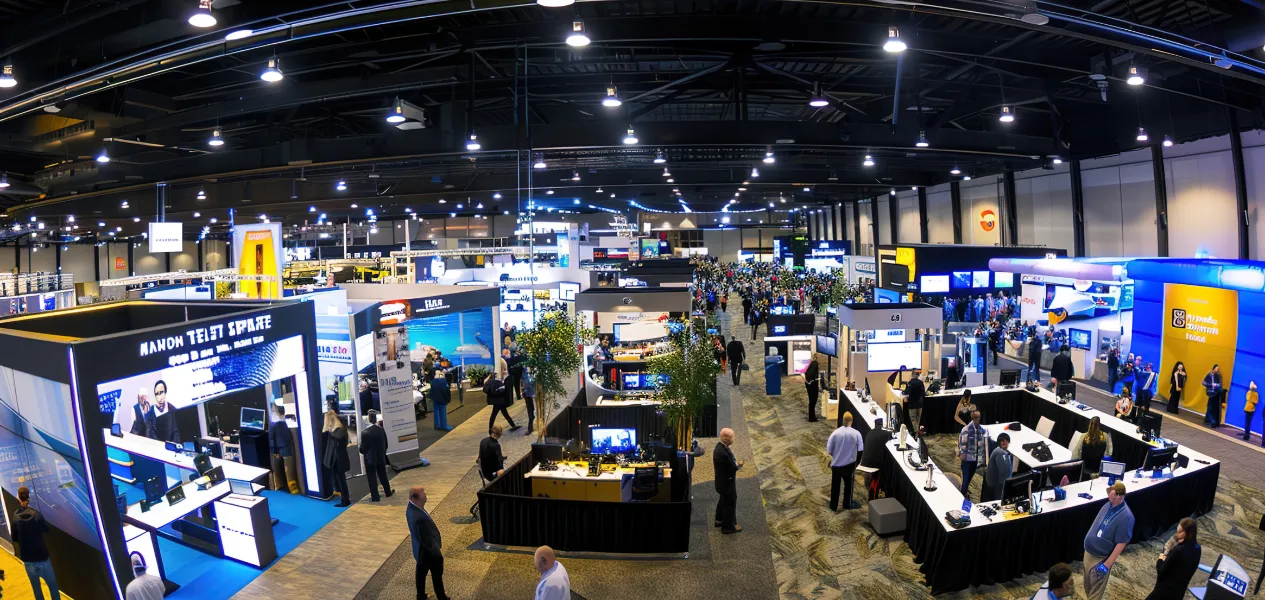
Your space's dimensions do not determine how great your impact can be. If your display is spectacular and
purposeful, it will probably gain more attention than the big, messy ones. The key is the efficiency of your
actions with the available resources. In a small space, the need for creativity makes you win in
competition.
The bottom line is: you are not trying to take over the area. You are trying to get attention. And attention
is a result of carefully planned design, concentration, and experience-driven storytelling.
A great number of exhibitors attempt to cram large-scale ideas into a small Exhibition Stand. What is the
outcome? The booth is overcrowded, unclear, and easily passed by. Small areas necessitate simplicity.
Establish your presence's main aim, which is raising product awareness, lead capture, and live interaction.
Eliminate everything that does not contribute to that specific outcome.
One message. One visual anchor. One action to promote. Visualize your booth as a headline that people
immediately get, rather than a container.
Your square footage is restricted, but you can still use the vertical space. Have towers, hanging items, digital displays at a high mount, or even adjustable light beams to attract attention from the opposite side of the hall. A small but visually striking Exhibition Booth will automatically win through the noise of the crowd.
What is more, height aids distance visibility as well. In crowded trade fairs where visitors are more likely to look over their heads instead of through the masses, vertical branding turns into a lighthouse. Just a simple hanging structure or an elevated light can show the way and attract more people. The fact that your booth is small will not matter at all if you manage to get the attention.
Clutter is a major hindrance to establishing trustworthiness. Having empty spaces signals self-assurance. The idea is that the visitors should feel that there is enough space for them to participate, rather than that they are just being allowed to squeeze in. Using a single point of attraction, such as a demonstration station or a vertical display, should be done together with the surrounding space being allowed to breathe.
Your Exhibition Booth should look like it has been curated rather than being cramped.
Static pictures are overlooked. People will remember the interactive moments. Engagement can be big even in a small area if the guests are invited to participate.
A five-second interaction is often more memorable than a big banner that nobody reads. Even the simplest hands-on moment shifts someone from passive visitor to active participant. Thus, turning fleeting curiosity into lasting recall.
Lighting is the best but also the most underrated tool in a small Exhibition Booth. Use it to change the
perception of things. Highlight the product that matters most, make the message points around it glow
softly, or create smooth transitions that almost automatically bring people nearer.
Lighting from a specific angle adds dimension. Warm colours provide a feeling of welcome. Cool colours make
digital content look sharper. All these small but important lighting choices around your stand can change
the whole atmosphere.
It’s not necessary to have a large screen; just the right one will suffice. The presence of just one vertical
display of high quality with motion graphics can quiet down a loud corridor. Keep the visuals short, easy to
understand, and looped for a reason. Do not go for lengthy videos or loud audios; your communication should
provoke interest, not complaints about noise.
Movement is crucial. Even the tiniest of motions will break the monotony of the visuals around a packed
Exhibition Booth.
In a small area, the staff presence is integrated into the overall scheme. Teach them to be welcoming, and do
not let them get hidden behind counters. Their manner, voice, and the first line they say can be very
influential.
You might try this: “In a tiny space, we are revealing something surprisingly powerful. Would you like to
have a preview?” It is in harmony with the theme, and it greets the visitors.
Limited spaces do not mean that your capabilities are less. They would rather reshape and enhance them. They
are compelled to be precise, to choose what really matters, and to come up with a very intelligent design.
The Exhibition Booth then becomes the place where every square inch is meaningful, where technology is
unobtrusive but still of great help, and where interactions are intimate.
The fact is that the small areas create greater impacts because they are very explicit. And clarity is
precisely what the crowded disorder of exhibitions frequently lacks. Limited space. High attraction. Mega
impact. This is how you secure your victory. That’s where Fusion Corporate
Solution excels. Not by occupying more space,
but by making yours unforgettable.
A small exhibition booth typically ranges between 3x3 meters or similar compact inline spaces provided by event organizers.
You can create the illusion of space by using vertical elements, proper lighting, mirrors, minimal furniture, and open layouts that avoid blocking sightlines.
Yes, a focused message, clear call-to-action, and engaging interaction strategy can help small booths generate high-quality leads effectively.
Bold, minimal branding with one strong visual and short messaging works best. Clear positioning helps visitors instantly understand your offering.
Seating can be included if space allows, but it should not block movement. Compact stools or foldable options are better suited for smaller stands.
Lighting is extremely important as it enhances visibility, creates depth, and directs attention to key products or messages within limited space.
Yes, a single well-placed digital screen with short, looping visuals can attract attention without overwhelming the limited area.
Usually 1–3 staff members are ideal for small booths to avoid overcrowding while maintaining smooth visitor engagement.
Avoid cluttered layouts, excessive text, oversized furniture, blocking entry points, and unclear messaging that confuses visitors.
Yes, small booths can stand out by focusing on clarity, creativity, and interactive engagement rather than trying to match the scale of larger setups.
Also Read: The Psychology of Booth Design: Attracting Visitors
Also Read: How to Choose the Right Exhibition Stand Type
Also Read: How 3D Design is Revolutionizing Exhibition Stands
Also Read: How to Design an Eye-Catching Exhibition Booth
Also Read: The Rise of Interactive AV (Audio-Visual) in Exhibitions
Also Read: Virtual vs. Physical Exhibitions: What Works Best?
Also Read: How AI is Transforming Event Engagement
Also Read: Mistakes to Avoid in Exhibition Planning